Wednesday, April 11, 2012

"Mundialito", Copa De Oro 1980

Le football uruguayen, autrefois célèbre pour ses résultats, jette toutes ses forces dans l'organisation de la Copa de Oro, afin de resurgir des ténèbres où il végète depuis trop longtemps. Ses derniers revers internationaux, son incroyable absence du Mundial, en Argentine, ont fait disparaître des grandes compétitions par équipes nationales la célèbre formation au maillot bleu, la Céleste. II s'est avéré nécessaire de créer un événement qui permettrait enfin à l'Uruguay de rejoindre les grands du monde du football. Pour ce faire, rien de mieux que d'organiser à domicile un tournoi de grande qualité : les possibilités de triompher sont ainsi plus grandes et le public revient en masse dans les stades. Ce sont ces sentiments qui ont amené les dirigeants de la fédération à organiser ce tournoi avec la participation des nations ayant déjà remporté un titre de champion du Monde. La commémoration du cinquantième anniversaire du premier tournoi mondial de la F.I.F.A. (disputé à Montevideo) est donc le meilleur prétexte pour cette proposition, à l'image de ce qui fut entrepris pour le Mundial argentin. L'énorme ferveur que provoquent les manifestations sportives de ce genre, ainsi que l'occasion de montrer au monde un peuple uni et heureux, encourageant l'équipe nationale, est quelque chose que n'importe quel gouvernement ne laisse pas passer : c'est ainsi que la Copa de Oro est devenue « une affaire d'Etat ».

Voici quelle fut l'histoire de ce « Mundialito » (une petite Coupe du Monde), mot qui peut sembler péjoratif pour les organisateurs, mais qui renferme une vérité : il s'agit bien d'un petit Mundial. Tous ceux qui avaient pu douter de ses répercussions ont dû déchanter; chaque sélection prend ce tournoi très au sérieux. L'Eurovision, dont le bon vouloir permet de rentabiliser aujourd'hui bon nombre de rencontres sportives, ne s'est pas montrée très généreuse pour les droits de retransmission en direction de l'Europe. Cela ennuie beaucoup les organisateurs dont le budget s'élève à 3 250 000 dollars (plus de 14 000 000 F). La fédération paye à chaque équipe invitée 150 000 dollars de participation et le reste consiste en frais de séjour, voyages et surtout restructuration du stade historique de Centenario où se jouent toutes les rencontres. Les travaux (nouvelle pelouse, installation d'un tableau d'affichage électronique, transformation des projecteurs à 1 200 lux pour permettre à la télévision en couleurs d'opérer, et amélioration des conditions de travail pour la presse) ont été récemment visitées par des membres de la F.I.F.A., emmenés par le président du Comité organisateur du tournoi, Hermann Neuberger.

Le dirigeant allemand était accompagné dans son inspection par des représentants des pays participants. Ceux-ci s'étaient déplacés, alarmés par des rumeurs européennes faisant état de retard dans les travaux. Mais les visiteurs ont reçu la promesse formelle que tout serait en ordre le 30 décembre pour la rencontre inaugurale entre la Hollande et l'Uruguay. Avant de partir, M. Neuberger a tout de même laissé tomber une petite phrase aussitôt reprise par tous les quotidiens : « Que Dieu les aide... » Sur le plan national, le succès économique, ou la promotion du pays, ne passe que par la victoire uruguayenne ou, pour le moins, par l'accession à la finale.

Si la Céleste rate son tournoi, le risque existe de voir les spectateurs déserter les stades au lendemain de la Copa de Oro. Au vu des dernières rencontres de la sélection, la situation ne permet pas vraiment de se montrer optimiste. Au moins, reconnaissons que l'avantage de recevoir joue un grand rôle dans ce genre de tournoi et que l'Uruguay a hérité du groupe le plus facile avec l'Italie et la Hollande comme adversaires. Mais pas un seul Uruguayen ne misera tous ses pesos en faveur de la Céleste... A la différence des autres participants au Mundialito, les footballeurs Uruguayens qui jouent à l'étranger ne seront pas convoqués. Le goleador Morena, qui évolue à Valence, en Espagne, ne sera pas présent, de même que les « Argentins » Carrasco et Gimenez (demis) et Alzamendy (attaquant). La grande responsabilité sera entre les pieds du groupe formé par la base du champion sud-américain, le Nacional de Montevideo. La sélection désignée par le directeur technique Roque Maspoli sera composée de : R. Rodriguez, H. Mo-reira, H. De Léon, N. Agresta, E. De la Pena, A. Luzardo, W. Victorino et J.-C. Morales (Nacional) ; F. Alvez, V.-H. Diogo, W. Olivera, D. Caceres, N. Marcenaro, M. Falero, E. Vargas, V. Ramos et R. Paz (Penarol) ; C. Goyen (River Plate); J. Barrios et A. Krasouski (Wanderers); D. Révélez (Bella Vista); D. Martinez (Danubio) ; R. Meroni (Defensor); J.-C. Nunez (Fenix); J. Siviero (Sud America).

Beaucoup de problèmes affectent la sélection. Le premier fut la désignation de l'entraîneur Maspoli, dont le titre de gloire le plus récent date de 1966. A cette époque, il dirigeait Penarol, alors champion intercontinental. Il fut aussi question de savoir si les joueurs devaient être rémunérés par la fédération ou si celle-ci allait verser au club une somme forfaitaire dont une partie serait reversée aux sélectionnés. Le consentement accordé à Hugo De Léon (le meilleur joueur que l'Uruguay ait produit depuis la retraite de Luis Cubilla) de pouvoir émigrer au Brésil seulement à la fin de Mundialito va mettre le joueur de Nacional dans une situation difficile. Malgré tout, quelque trente mille touristes (pour la plupart Argentins, d'ailleurs) viendront en Uruguay. Beaucoup d'entre eux habiteront chez l'habitant. Mille deux cent cinquante journalistes (dont cinq cents Argentins) couvriront l'information. Et c'est aussi une certitude que le stade sera prêt , avec l'aide de Dieu qui entendra le vœu de M. Neuberger...

Monday, April 9, 2012

READINGS : Liga 2011 2012 Real Madrid Valencia

8 April 2012
Estadio Santiago Bernabéu,
Madrid
Referee: Carlos Clos Gomez
Attendance: 72000

   Il y a quelques semaines, on pensait le sort de la Liga définitivement scellé. Au soir de la 32e journée, cette certitude s'est quelque peu envolée après les deux nouveaux points perdus par le Real, cette fois tenu en échec à Bernabeu par un bon Valence (0-0). Une contre-performance de la part des Merengue qui ne comptent plus que quatre points d'avance sur Barcelone à six journées du dénouement de la saison. Pourtant, très vite, les hommes de Mourinho se mettaient en exécution à l'image de Ronaldo qui se montrait menaçant sur ses tentatives lointaines (4e, 8e, 14e). Quelques instants plus tard, le Portugais - bien servi par Benzema - butait sur Guaita, auteur d'un sauvetage décisif qui maintenait son équipe à flots au terme d'un début de match 100% madrilène (19e). Mais Valence, en pressant haut, finissait par se procurer des contre-offensives intéressantes. A tel point que Casillas devait s'interposer pour empêcher Piatti d'ouvrir la marque (34e). Quelques instants auparavant, le portier du Real était sauvé par son montant sur une tête plongeante à bout portant de Ricardo Costa (25e).

 Tenu en échec pendant le premier acte, le Real Madrid l'était à nouveau pendant la deuxième période. Présents dans les duels, les Valenciens imposaient un défi physique qui ne faisait qu'accentuer l'agacement perceptible des Merengue. Un symbole témoignant de l'incapacité des hommes de Mourinho à prendre réellement le jeu à leur compte. Certes, des parades miracles de Guaita privaient Di Maria (77e) puis Benzema (78e) de l'ouverture du score, mais l'essentiel du danger se trouvait étonnamment dans la partie de terrain madrilène. Souvent prise à revers en contre, la défense du Real était à nouveau sauvée par la transversale sur une tentative lointaine de Tino Costa (55e) puis par Casillas qui s'interposait en fin de match face à Alba (85e). Malgré un gros pressing du Real dans les dernières minutes, les troupes de Mourinho ne parvenaient pas à tromper la vigilance de l'imperméable Guaita. Un résultat satisfaisant pour Valence qui préserve sa troisième place. 

 Mais frustrant pour le Real qui sent à nouveau le souffle de Barcelone dans son dos. Petit évènement en Espagne : le Real n'a pas marqué en compétition officielle. Phénomène qui n'était plus arrivé depuis le 21 septembre et un match nul à Santander (0-0). Alors qu'ils restaient sur une série de 18 buts inscrits en quatre matches, les Merengue ont cette fois buté sur un Vicente Guaita en état de grâce. Auteur de multiples parades et d'interventions rassurantes, le portier espagnol a été un atout précieux pour Unai Emery. Et, sur sa seule erreur de la soirée, il a été sauvé par son montant… Preuve que rien ne semblait pouvoir lui arriver à Bernabeu… Titulaire à la pointe de l'attaque madrilène, Gonzalo Higuain est passé à côté de son sujet au cours d'une première période qui ne lui a pas permis de se mettre en valeur. Bien au contraire, l'Argentin a manqué de poids pour peser sur la défense adverse, décidée à ne pas laisser le moindre centimètre disponible dans ses seize mètres. Faute de pouvoir s'exprimer, l'attaquant a finalement dû céder sa place pendant la mi-temps pour des raisons tactiques. 

Metropolitano 1981: Platense Boca Juniors

5 June 1981
Estádio do Velez

Árbitro: Ducatelli

Platense: Biassutto, Corté, Correa, Guyón, Turtich, Picerni, Magalhaes (Gomez), Grimoldi, Eleuterio Montes
(Scotta), Anzarda, Bóverda. Tec: Vladislao Cap

Boca: Rodriguez, Pasucci, Mouzo, Alvez, Benitez (Ramoa),  Krasouski, Maradona, MOrete, Brindisi (Alves), Perotti. Tec: Silvio Marzolini.

Sunday, April 8, 2012

Minicopa 1972: Brazil Yugoslavia

2 July 1972
Competição (Competition): Minicopa (Brazil Independence Cup)
Local (Place): Estádio do Morumbi
Cidade (City): São Paulo (Brasil/Brazil)
Árbitro (Referee): O. Dahlberg (Suécia/Sweden)

Brasil (Brazil): Leão, Zé Maria, Brito, Vantuir, Marco Antônio, Clodoaldo, Gérson, Jairzinho, Tostão, Rivellino, Paulo César Caju (Leivinha). Técnico (Coach): Zagallo

Iugoslávia (Yugoslavia): Maric, Krivokuca, Katalinski  (Paunovic), Pavlovic, Stepanovic - Oblak, J. Jerkovic,  Acimovic (Sandrac) - Popivoda, Bajevic, Dzajic Técnico (Coach): Vujadin Boskov

Friday, April 6, 2012

FA Cup 2011 2012 Chelsea Leicester


Quarter-final
18 March 2012
Stamford Bridge (London)
Referee : Lee Probert
Attendance : 38276

  Fernando Torres a retrouvé le chemin du but après des mois de disette en inscrivant un doublé dimanche lors de la large victoire de Chelsea sur Leicester, 5 à 2, en quarts de finale de la Coupe d'Angleterre. L’espagnol n'avait plus marqué depuis le 19 octobre et un doublé réussi en Ligue des champions contre les Belges de Genk, soit 26 matches et plus de 25 heures de football avec son club et la sélection sans faire trembler les filets.

"J'avais besoin de ces buts, j'ai travaillé dur pour y arriver. Ces derniers temps, je jouais mieux même si je n'avais pas encore réussi à marquer", a dit Torres, qui était titulaire dimanche à Stamford Bridge pour la deuxième fois seulement en huit matches. Le Madrilène, acheté pour la somme record de 58 millions de livres à Liverpool en janvier 2011, a marqué le troisième but des "Blues" à la 67e minute, d'une frappe en finesse sur un centre de Meireles, puis le quatrième de la tête sur un corner du même Portugais (85). Il a aussi donné deux passes décisives Kalou (17) et à Meireles (90). Cahill avait ouvert le score de la tête (12).

Les Londoniens continuent sur leur lancée de quatre victoires en quatre matches depuis la prise de fonctions de l'entraîneur Roberto Di Matteo, qui a remplacé Andre Villas-Boas, limogé il y a deux semaines.  Depuis Chelsea s'est notamment qualifié pour les quarts de finale de la Ligue des champions en retournant la situation contre Naples (1-3, 4-1).


Monday, April 2, 2012

Serie A: 1982 1983 Juventus AS Roma

 Allez en Italie. N'importe où. Piémont ou Toscane. Lombardie ou Calabre. Sardaigne ou Vénétie. N'importe où : le premier stade de calcio que vous trouverez- Dans la foule colorée,  choisissez  au hasard un interlocuteur. Hypocritement, amadouez-le. Quelques basses flatteries sur son équipe préférée (« Bella squadra, he, bella squadra ! »), quelques compliments sur l'idole locale (« Untelli, stupendo giocatore, no?»). Quand vous le sentez prèt a elargir le débat, prononcez alors deux syllabes magiques (en « coulant » un peu le r) : «Roma?». Deux solutions : votre tifoso est un irréductible qui n'a d'yeux que pour les siens, et alors file vite a l'autre bout du stade. Ou bien il voit plus loin que le bout de sa passion, et il vous répondra sans hésiter : « Roma ? Maravigliosa ! La zona, la zona ! ». La « Zona ». Si vous préférez, la défense en zone. Révolution dans le calcio. La Roma, osant braver l'ordre établi (au moins depuis Garibaldi !), osant aller a Pencontre d'un conformisme tactique erige en règie formelle, a sacrifié le sacro-saint « catenaccio », l'intouchable marquage individuel, au profit de la défense en zone. Et c'est en abandonnant celle caractérislique principale du football ilalien que la Roma, au lerme d'une saispn éblouissante, a remporté son deuxième «scudetto»... 

Sunday, April 1, 2012

Liga 2011 2012 Osasuna Real Madrid

   Le Real Madrid a écrasé l'Osasuna Pampelune (5-1) à l'extérieur, Ronaldo et Higuain inscrivant chacun un doublé, Benzema complétant d'un but splendide cette démonstration offensive des Blancs. Les Madrilènes ont d'abord surclassé par leur jeu de possession un Osasuna dépassé en première période. Dans le second acte, ils ont su enfoncer le clou, tuant rapidement un timide réveil des Navarrais qui ont sauvé l'honneur par Nino (48). Dès l'entame de match, Pampelune a été pris à la gorge par le jeu extrêmement incisif du Real. Bien servi par Ronaldo, Benzema expédiait ainsi sur un de ses premiers ballons une sublime reprise de volée dans la lucarne droite d'Andres Fernandez (1-0; 7e). 

Monday, March 26, 2012

Campionato 2011 2012 Napoli Catiana

25 March 2012
Stadio San Paolo,
Napoli

Referee: A. Gervasoni
Attendance: 44000  

  Cet après-midi le Napoli recevait une équipe de Catania en bonne forme et assez proche de Napoli au classement. Dès le début du match l’équipe évoluant à domicile cherche à s’imposer et se créer des bonnes occasions mais la défense de Catania est solide. Les hommes de Montella se procurent également quelques occasions qui ne donneront rien non plus. La suite de la première mi-temps montrera un scénario plus ou moins similaire : les attaquants partenopei buteront sur un Carrizo en grande forme, tandis que les rossazzuri n’arriveront pas à convertir leurs quelques occasions et leur bonne possession du ballon. La première mi-temps se conclut donc sur un 0-0 grâce notamment à un excellent Carrizo.  (Suit sur Calciomio)

Goals : Dzemaili (61′), Cavani (67′), Spolli(75′), Lanzafame (85′)
Napoli (3-4-3) : De Sanctis, Campagnaro, Fernandez (66′ Cannavaro), Aronica; Zuniga, Gargano, Dzemaili, Dossena; Hamsik (58′ Pandev), Lavezzi (76′ Inler); Cavani. A disp.: Rosati, Fideleff, Amendola, Vargas. Entr.: Mazzarri.
Catania (3-5-2): Carrizo; Bellusci, Legrottaglie, Spolli ; Barrientos (79′ Ricchiuti), Izco, Lodi, Almiron, Marchese(72′ Llama); Gomez (Lanzafame 83′), Bergessio A disp. : Kosicky, Seymour, Catellani, Ebagua Entr. : Montella

Thursday, March 22, 2012

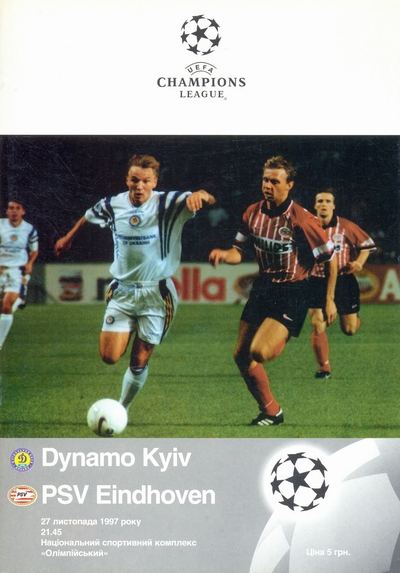
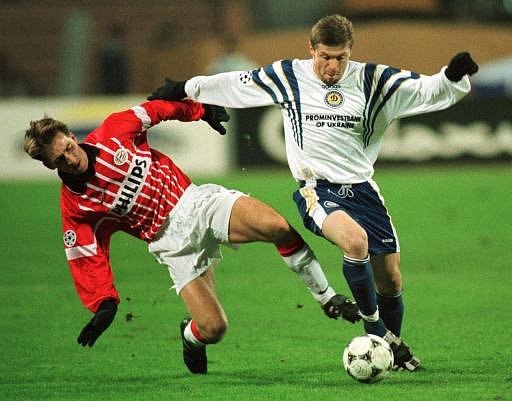
Champions League 1997/1998 Dynamo Kyiv PSV Eindhoven


November 27, 1997
Olympic Stadium
(NSC Olympiysky)
Kyiv, Ukraine
80.000 spectators
Referee: P. Ceccarini (Italy)

Dynamo Kyiv: Olexandr Shovkovsky, Olexandr Holovko, Vladyslav Vashchuk, Yuri Dmytrulin, Oleg Luzhnyi (87` Mykola Volosianko), Aleksandr Khatskevich, Vitali Kosovsky, Yuri Kalitvintsev, Yuri Maksymov (83` Serhiy Bezhenar), Serhiy Rebrov, Andriy Shevchenko. Coach: Valery Lobanovsky.

PSV Eindhoven: Ronald Waterreus, Ernest Faber, Jaap Stam, Philip Cocu, Wim Jonk, Arthur Numan, Ovidiu Stinga, Vampeta, Tomasz Iwan (38`Stan Valckx), Gilles De Bilde (82`Marc Degryse), Luc Nilis. Coach: Dick Advocaat.


English Leagues the 70s: Ipswich Town Orient FA Cup 1978 1979

27 january 1979
Portman Road,
Ipswich

 It all happened so suddenly, so dramatically, so unexpectedly. In late June, Osvaldo Ardiles and Ricardo Villa were helping Argentina win the World Cup. By mid-July — by way of a cloak-and-dagger Transatlantic dash by enterprising young manager Keith ("007") Burkenshaw; plus around three-quarters of a million quid — we heard the dynamic duo would soon be gracing the English First Division in Tottenham shirts. That was the first big sensation of the season so far — and, ironically. Spurs were to figure largely in the second, too. And that was in some of the weird and wonderful early scorelines. Especially so in the League Cup in which, by the first week in September,  Spurs had become the eighth embarrassed First Division side to be unceremoniously dumped out of the competition by teams from the lower orders. 

It was team-to-watch Third Division Swansea — old Uncle Tommy Smith and all — who clobbered Spurs at home ... just four days after they'd been thumped 7-0 at Anfleld. Liverpool — even though they themselves experienced a shock hiccup by being K.O'd from the League Cup by Second Division Sheffield United — started their own season in devastating form. Not that fact in itself can be included In any catalogue of sensations! Even so, even by their own almost monotonous high-standards, they seemed to surpass themselves in the early days of 1978-79. Everything, really, was climaxed in that Tottenham demolition-Job — In which hardly a Liverpool pass went astray — that prompted even the normally taciturn Bob Paisley to comment afterwards: "We mustn't let go to our heads — but our football today was frightening." And to any future opponents of Liverpool watching the game — even by way of highlights on TV — it cortainlv was! Tottenham, nonetheless, kicked-off well, with a promising 1-1 draw on the ground of League Champions Forest — who didn't! In fact, after four League games, they still hadn't won — and that single goal remained their only one. True, they won 4-2 in a League Cup replay against Oldham — but only after being held away by the Second Divisioners. So... more Surprises coming ...?

Tuesday, March 20, 2012

TO UPDATE Division One 1978 1979 Leeds Manchester City

13 January 1979
Elland Road,
Leeds

Attendance 36,30

  This has been the season in which the First Division has been split into three distinct groups — the elite, the also-rans and the strugglers. Without naming them, the clubs in the middle bracket know who they are. The strugglers are Birmingham, Chelsea, Q.P.R.. Wolves, Middlesbrough and Botton, all liable to go down to the Second Division, at some stage of the season. This definitive split has come about because the Magnificent Six have been able to draw away from the pack and form virtually an exclusive club, Liverpool, Everton, West Bromwich Albion, Arsenal, Leeds United and Nottingham Forest unquestionably offer all that is best in British football. Liverpool, of course, have been almost permanent members of that group for the past 20 years; Everton have been trying to match them without quite succeeding; Albion have come of age this season; Arsenal's progress has been gathering pace over the past two years; and Forest wrote their own names in with brilliant style by almost sweeping the board on their return to the top. That leaves Leeds and their progress this season has been impressive. the extraordinary fact is Leeds could have been excused for losing their feet on a banana skin after the sort of upheavals they've suffered. The season began without a manager at Elland Road after the departure of Jimmy Armfield and only one of the first four matches was won. Then Jock Stein arrived and all appeared sweet and light — until that is Scotland found themselves looking for Ally MacLeod's successor and naturally enticed the Big Man.


At that stage Leeds could have felt the whole world was against them and been lulled into a careless sort of attitude. Interestingly the reverse happened. Things continued to tick over until the arrival of Jimmy Adamson, and since the quiet man left Sunderland for Elland Road there has been barely a dull moment. The only disappointment came with the League Cup Semi-Final defeat by Southampton, but in terms of the First Division there has been no more convincing side as the record for Adamson's first . 17 games proved: Won 10 Drawn 6 Lost 1 Goals (for) 33 (against) 15. One man in particular who appreciates what's going on at Elland Road is Scottish international goalkeeper David Harvey, one of the few survivors of the Don Revie era. "Only Eddie Gray, Peter Lorimer, Paul Madeley and myself of the current squad were here at the turn of the Seventies, and of the rest most have been bought within the last three seasons. "I can honestly say this is now the best team we have had since the super team of the Sixties .. . the days of Bremner and Giles, Hunter and Cooper, Clarke and Jones," he says. Harvey's own position has become clearer in recent weeks. With the sale of another Scottish international 'keeper David Stewart to West Brom he has now re-established himself as the number one at Leeds.

"David and I have been alternating over the past couple of seasons getting about 20 odd games apiece in the First Division. Sometimes one has been injured letting the other one in, occasionally we've both been dropped. "People talk of competition being good for you in terms of keeping you on your toes, but it doesn't always work that way. Providing a goalkeeper is playing well he should have peace of mind so far as his place is concerned, but when there's someone as good as Dave standing in the wings it can bring a touch of nervousness to your play. "i honestly believe I'm keeping goal as well as ever at the moment, and my one burning ambition is to get back into the Scotland side. My application hasn't always been what it might have been, but I'm enjoying my football now as much as at any time in my career. "Once you've kept goal in international football it's hard to accept someone else is in the position you think you should be occupying. Scotland have had a succession of goalkeepers since I last played, and I'm just hoping now that Jock Stein comes and has a look at me again. "He knows my capabilities having been at Elland Road even for such a short period, and I'm praying he doesn't forget me." Harvey, who has played over 300 times for Leeds, recalls with utter despair the League Cup Semi-Final defeat by Southampton. "We really fancied our chances in that one — and perhaps that was our undoing. We'd beaten Southampton 4-0 in the League only a few weeks before and we turned them over to such an extent that subconsciously we probably thought it was going to be easy.

"After going two up just after half-time in the first-leg we should have sewn it up but we didn't and we were punished with two bad goals and then defeat in the return. 'That's the third Semi-Final in a row we've lost. "I suppose you could say that's the difference between the current side and the one which brought us all those honours. "I'm sure this side will have learned a lesson. Lads like Paul Hart and Brian Flynn are learning all the time. Paul, In particular, had an awful start when he pmed us from Blackpool. "Brian also took time to settle in, but I've never seen anyone work so hard, and he's very skilful. He and Tony Currie must be one of the best midfietd combinations in the game. 'This season we've gone to Liverpool and Everton and led them both until the closing stages of the game before conceding a point, we've also won at West Brom in the League, drawn there twice in the F.A. Cup and League Cup, drawn at Arsenal and won at difficult grounds like Tottenham, Ipswich and Chelsea 'Team spirit is super and I reckon we've now got a squad that can only get better. "The way things are going right now we're a must for Europe next season and that means an awful lot to Eddie, Paul and myself who enjoyed some great moments in Europe and have hankered for another crack ever since the ban that was imposed after the European Cup final fiasco in Paris. 'The team we have now can win trophies I'm quite sure, and I'm looking forward to another successful period at Leeds," he says.

English Leagues the 70s: Sheffield Wednesday Arsenal FA Cup 1978 1979

06 January 1979
Hillsborough Stadium,
Sheffield

 The scene was now set for the highlight of the 20-year gap between the Championships of 1971 and 1989 - the hat-trick of Cup finals of 1978,1979 and 1980. The Gunners contrived to win the one they were expected to lose and to lose the two they were expected to win, but that is a typical example of what appearing at Wembley can do. The 1978 game was to be a 0-1 defeat by Ipswich, the 1979 game was to be the 'five-minute final' concluding in the 3-2 victory over Manchester United, and the 1980 final was to be the 0-1 defeat by Second Division West Ham. Arsenal became the first club to reach three successive Wembley FA Cup finals and only the third ever to achieve a hat-trick of finals. The 1978 FA Cup rounds were to see an impressive progression-five successive wins (Sheffield United, Wolves, Walsall, Wrexham and Orient) with 17 goals scored, seven from Macdonald who scored in every game except the final. That being said, it was not the toughest test a finalist has faced, and the Wembley confrontation was to be an unhappy experience. Brady was not fit and had to be substituted, Macdonald was to end with a third losers' medal and was never to have another chance - three days later he went into hospital for the first of many knee operations that ended his career at the age of 29. Roger Osborne scored the only goal for Ipswich to win the contest.


English Leagues the 70s: Manchester United West Bromwich Albion Division One 1978 1979

30 December 1978
Old Trafford,
Manchester

Attendance 45,091


  For Ron Atkinson, his team’s 5-3 victory over Manchester United at Old Trafford 30 years ago this December is memorable for one of the most pointless half-time team talks he ever delivered. ‘I went in and told them that they didn’t deserve to be losing 3-2 and that there was no reason in the world why we should not grab an equaliser,’ recalled Atkinson. ‘They all just sat there and looked at me like I was mad. ‘Then Tony Brown said: “Boss, it’s 3-3. I have just equalised.” ‘Bomber had just run through and put the ball in at the Stretford End but I had heard a whistle blow. 'I thought it had been too late. I thought it was half-time already. ‘And there he is staring at me as if I had just lost my marbles. ‘So I just told them: “Fair enough. Then go and get me a winner then”.’

Wherever you choose to watch your football today of this famous game first. As United and West Bromwich prepare to meet at Old Trafford again, it is guaranteed to send you to your team’s match in better spirits. There is an undeniable feel-good factor about it, even if it is hard to pinpoint exactly why. It may be commentator/presenter (you had to do both jobs back then) Gerald Sinstadt’s ridiculous moustache. Or the excited yelp with which he greets the final goal, crashed in to the roof of the net by Cyrille Regis. Maybe it’s the way that Laurie Cunningham ignores the racist booing from the terraces to set up Albion’s first goal , or the hilariously crude manner in which Stewart Houston shamelessly tries to hack him down en route to scoring in the second half. It could even be the way that United manager Dave Sexton nominates Steve Coppell as man of the match. Coppell doesn’t even appear to be playing on the highlights reel. But, more than likely, it will be the uninhibited, expressive nature of the football that grabs you. Of the eight goals, at least five are as good as anything the Barclays Premier League has offered so far this season. Atkinson’s Albion had a young Bryan Robson in the centre of midfield and were graced by three black players, Cunningham, Regis and Brendon Batson. It was unique at the time for an English team to be so racially mixed.

 The trio were then nicknamed —quite unbelievably — ‘The Three Degrees’. 'We arrived at Old Trafford playing great football,’ said Atkinson, who went on to manage United. ‘I look at the way Arsenal play now and think that’s the way that we used to knock it about. 'So I wasn’t really surprised to see us playing like that on the day at Old Trafford. ‘We had a very powerful team and could be quite direct when we needed to be. 'Robbo was beginning to come into his own and Derek Statham was one of the best left-backs I have seen. ‘But players like Laurie and big Cyrille were superb. 'Laurie was so light and so delicate. He could have run on snow without leaving footprints. 'We were capable of some smashing stuff and it was certainly one of the most enjoyable spells of my time in the game. 'My only regret was that we should really have gone on to win the league that year and we didn’t.’ Hindered by an end-of-season fixture pile-up, Albion finished third in the old First Division — United ended ninth — and they reached the last eight of the UEFA Cup. Atkinson moved to United as Sexton’s successor two years later, taking the likes of Robson with him. ‘I didn’t rate Robbo at first,’ is now Atkinson’s frank admission. ‘All I could see was the permed hair that made him look like Kevin Keegan. ‘At the time I thought that was all they had in common. 'But I was wrong. I had to play him as centre half in an FA Cup replay early in 1978 — ironically against United — and he obliterated Joe Jordan. ‘He was 19 and was magnificent. A brain-rocking revelation. He never looked back after that.’

Monday, March 19, 2012

Sunday, March 18, 2012

FA Cup 2011 2012 Sunderland Middlesbrough


Round of 32
29 January 2012
Stadium of Light, Sunderland
Referee : Kevin Friend
Attendance : 33275


 The striker, whose last goal came over 500 days ago, came off the bench to rescue his side with a lovely finish from a Black Cats counter attack on the hour mark. Middlesbrough had taken the lead against the run of play after 16 minutes when Barry Robson volleyed home a spectacular strike after confusion in the Sunderland defence. Neither side could find the elusive winning goal though and with the draw Martin O'Neill maintained his unbeaten record at the Stadium of Light, whilst Boro fans will be delighted with their side's performance against Premier League opposition.

Martin O'Neill named a strong starting lineup for Sunderland with Stephane Sessegnon partnering youngster Connor Wickham in attack.  The visitors were missing Julio Arca and Kevin Thomson through suspensions, after their red cards against Coventry. The Black Cats largely dominated the first half but were always susceptible to a Boro counter attack, with the first goal of the game firm evidence of that. Faris Haroun managed to escape down the right, and after his cross wasn't dealt with by John O'Shea, the ball fell perfectly for Robson who struck a sumptuous volley across Simon Mignolet into the far corner. O'Neill's men did trouble the Boro defence every time they came forward though, with Sessegnon playing a prominent role in attack. The Benin international had already seen his cross headed wide by Sebastian Larsson before he teed up Craig Gardner for a crashing volley which dipped just over the bar. Boro keeper Danny Coyne then produced two fine saves to preserve his side's advantage when he made a double stop from James McClean.

The Northern Irish winger ran onto Wickham's flick-on before shooting low at Coyne, before heading straight at the keeper from David Vaughan's resulting cross. Then, the talking point of the first half came. Kieran Richardson's lofted ball into the box appeared to have been chested down by Gardner before his strike went in via the post. A halt was brought to the Black Cats' celebrations as the linesman deemed that Wickham, who was offside, had got a touch on  Gardner's strike before it hit the back of the net. Television replays showed that this wasn't the case but that Gardner had handled during the build-up to the finish.

It was a major let-off for Boro, but it was Tony Mowbray's men who would then give the Black Cats a let off themselves as they should have doubled their lead on the stroke of half-time. Faris Haroun advanced on the right flank again and released Lukas Jutkiewicz who forced Mignolet into a fine stop. The Belgian midfielder had carried on his run however and when it came back to him, his touch deflected back to the striker who could only volley wide first time, when he perhaps had more time than he thought.
The second half though, belonged to Campbell. The livewire striker stepped off the bench to replace Connor Wickham at half-time and his presence was well and truly felt on Wearside. Boro created several chances in the opening ten minutes of the second half but Marvin Emnes and Robson both wasted good openings.

Mowbray's side, and in particular Robson, would pay for their profligacy. It was Robson who went from hero to zero as he handed McClean possession on the halfway line. The winger released the onrushing Campbell, who slid home first-time past the previously unbeatable Coyne to the delight of the Mackems fans. The goal proved to be a slightly brighter note on the second half for Sunderland as they lost Wes Brown to a nasty-looking knee injury just minutes before that strike as he tussled with Emnes before falling heavily.

Chances from there on were few and far between as Middlesbrough appeared to settle for a draw but they did force Phil Bardsley into heading into the side netting before Emnes volleyed high and wide when well placed from the subsequent corner. Boro were forced into a change of their own as Coyne was replaced by youngster Connor Ripley, who made his FA Cup debut, but he was largely untroubled throughout his 10 minute stint between the sticks. Sunderland mustered one last foray forward, but after good interplay by Sessegnon, McClean fired his shot just past the post. It was the last meaningful action and it means that the two sides will do battle once again in nine days' time.